Traffic is expensive.
Losing it is even more expensive.
Casino and sportsbook operators invest across affiliates, paid media, sponsorships, SEO, partnerships and performance campaigns to bring potential players to their websites.
But arriving on the site is not the same as converting.
A visitor can explore an offer, compare games, check a sportsbook market, reach the registration journey and still leave without taking the next step.
At that moment, the acquisition opportunity usually disappears with them.
Promofy Spark is designed for that moment.
Instead of allowing high-intent traffic to leave through the same static experience it entered, Spark uses real-time behavioral signals to activate interactive onsite experiences while the opportunity to influence the session still exists.
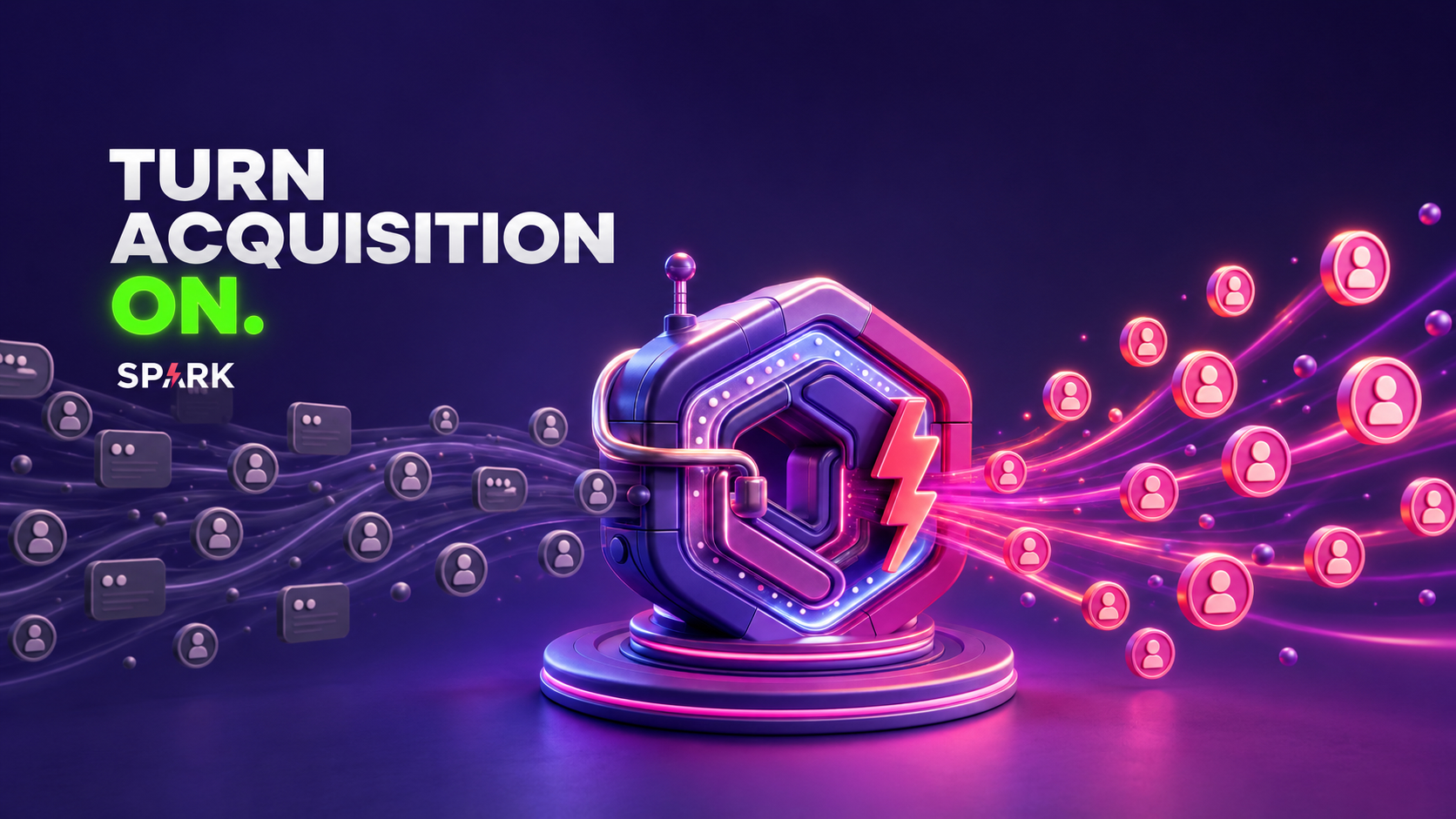
Traffic is already on.
Spark turns conversion on.
The iGaming Acquisition Problem Is No Longer Just Traffic
For years, player acquisition has largely been treated as a traffic problem.
More affiliates.
More campaigns.
More paid media.
More impressions.
More clicks.
But there is another side of the acquisition equation:
What happens after the click?
Consider a sportsbook acquiring 100,000 visits during a major tournament.
Those visitors have already cost money to acquire.
Some will register immediately.
Some will browse.
Some will compare promotions.
Some will reach the registration or deposit journey and hesitate.
And some will leave.
The moment those visitors arrive, increasing acquisition efficiency is no longer only about buying another click.
It becomes a conversion problem.
For operators facing increasing acquisition pressure, improving the value generated from existing traffic can be just as important as increasing traffic volume.
That challenge sits within a much wider shift in iGaming industry trends for 2026, where operators are increasingly focused on smarter engagement, personalization, retention and more efficient use of existing player traffic.
That is the gap Promofy Spark is built to address.
High Intent Does Not Always Look Like a Registration
Traditional acquisition funnels often divide users into simple groups:
Visitor → Registered Player → First-Time Depositor
Real behavior is less linear.
A visitor might:
- view several casino games
- scroll through a welcome offer
- remain on a sportsbook page for several minutes
- visit the registration page
- interact with a CTA
- return to an offer multiple times
- begin moving toward leaving the website
None of those actions is a completed registration.
But together, they tell a story.
Intent is forming.
The problem is that a static website usually responds to all of those visitors in almost exactly the same way.
Spark adds another layer.
Instead of waiting for the user to convert or disappear, behavioral signals can determine when an additional experience should appear.
From Behavioral Signals to Conversion Moments
Promofy Spark can respond to onsite behavior such as:
Exit Intent
A visitor begins moving toward leaving the experience.
Rather than losing the session immediately, the operator can introduce one final relevant interaction.
Time on Page
A user has spent meaningful time considering a game, market, promotion or registration page without progressing.
That hesitation can become a trigger.
Scroll Depth
A visitor has consumed most of a page but has not interacted with the primary conversion action.
Spark can introduce another route forward.
Page Visits
Repeated visits to relevant pages can indicate stronger interest than a single pageview.
Button Interactions
Specific interactions can become signals for what should happen next.
The objective is not to interrupt every visitor.
It is to identify conversion moments.
Then respond while the user is still there.
The same principle extends deeper into the player lifecycle, where real-time gamification in iGaming can connect player actions with relevant engagement experiences while the context of that action still matters.
Interaction Instead of Another Popup
Traditional website popups often follow a simple formula:
Wait five seconds → show banner → offer discount → close
The visitor has done nothing to trigger it.
The experience has little context.
And eventually users learn to ignore it.
Spark takes a different approach.
The interaction can be tied to what the visitor is actually doing.
Instead of another static message saying:
Register Now
the visitor could receive an interactive experience such as:
- Scratch Card
- Spin Wheel
- Mystery Box
- Interactive Offer
- Registration Reward
- Targeted Banner
That changes the dynamic.
The visitor is no longer simply being shown another advertisement.
They are being invited to do something.
And interaction creates another opportunity to move the session forward.
Example: Turning Exit Intent Into Acquisition
Imagine a new visitor arrives through a paid campaign promoting a casino welcome offer.
They browse several games.
They open the promotion page.
They remain on the site for four minutes.
But they do not register.
Then they begin to leave.
Without an engagement layer, the journey ends:
Ad Click → Website Visit → Browse → Exit
Spark can create another path:
Ad Click → Website Visit → Browse → Exit Intent → Interactive Experience → Registration Opportunity
For example, the exit signal could trigger a branded Mystery Box giving eligible users the opportunity to unlock a registration-related reward.
The important point is not the Mystery Box itself.
The mechanic is only the interface.
The real value is timing.
Spark gives the operator another opportunity to act between interest and abandonment.
Stop Paying Twice for the Same Acquisition Problem
When conversion rates underperform, the natural reaction is often to increase acquisition volume.
More budget.
More traffic.
More campaigns.
But increasing traffic does not fix conversion leakage.
If the website fails to engage visitors at critical decision points, increasing media spend can simply send more people through the same leaking funnel.
A more efficient acquisition strategy asks two different questions:
How do we bring qualified users to the website?
And:
How do we convert more of the qualified users who already arrived?
Spark focuses on the second question.
It does not replace affiliates, paid media, SEO or other acquisition channels.
It gives those channels another opportunity to produce value.
The same principle becomes important after acquisition as well. In sportsbook environments, gamification in sports betting can help connect initial player activation with longer-term participation, progression and retention.
Turn On Campaigns Without Turning On a Development Project
There is another conversion bottleneck that operators regularly face.
Internal execution.
Marketing identifies an opportunity.
A campaign concept is created.
Design work is requested.
Development receives a ticket.
Implementation gets prioritized.
Testing follows.
The opportunity waits.
For seasonal campaigns, major sporting events and fast-moving acquisition opportunities, that delay matters.
Spark is designed as a lightweight engagement layer that can be deployed through a single script tag and managed without turning every onsite acquisition experiment into a development project.
Once implemented, marketing teams can build and launch experiences without repeatedly entering the development roadmap.
That changes Spark from simply another website widget into an operational capability.
See an opportunity.
Build the experience.
Define the trigger.
Launch.
Acquisition Teams Should Be Able to Experiment
Conversion optimization depends on testing.
Operators should be able to ask questions such as:
Does an exit-triggered Scratch Card outperform a static registration offer?
Does a Mystery Box work better for casino traffic?
Should sportsbook visitors receive a different experience during match days?
Does the trigger perform differently after two page visits compared with five?
Which offer generates registrations without creating unnecessary promotional cost?
Those questions become difficult to answer when every experiment requires development work.
A lightweight behavioral layer makes experimentation significantly easier.
Instead of treating the website as a fixed conversion funnel, operators can begin treating it as an environment that adapts to visitor behavior.
Spark Can Work Before the CRM Journey Begins
CRM systems are extremely powerful once a customer becomes identifiable.
But an important acquisition gap exists before that point.
An anonymous visitor who has not registered may sit outside the traditional player lifecycle.
There may be:
No player ID.
No lifecycle stage.
No CRM segment.
No retention campaign.
Yet the visitor can still be demonstrating meaningful intent.
Spark gives operators the ability to act earlier.
That also means an operator does not need to redesign its entire CRM environment before beginning to improve onsite conversion.
Spark can operate as a standalone acquisition layer while also becoming part of Promofy’s wider engagement ecosystem as the operator’s infrastructure develops.
From Acquisition to the Wider Player Journey
The bigger opportunity appears when acquisition does not end with registration.
A visitor becomes a registered user.
The registered user becomes a depositor.
The depositor begins playing.
And every stage creates new engagement opportunities.
That is where Spark connects with the wider Promofy engagement ecosystem.
The journey can evolve from:
Spark → Registration
into:
Registration → Activation → Gamification → Progression → Loyalty
A player acquired through an interactive Spark experience does not need to enter another disconnected promotional system.
The relationship can continue through missions, challenges, Free-to-Play experiences, leaderboards, rewards and longer-term progression.
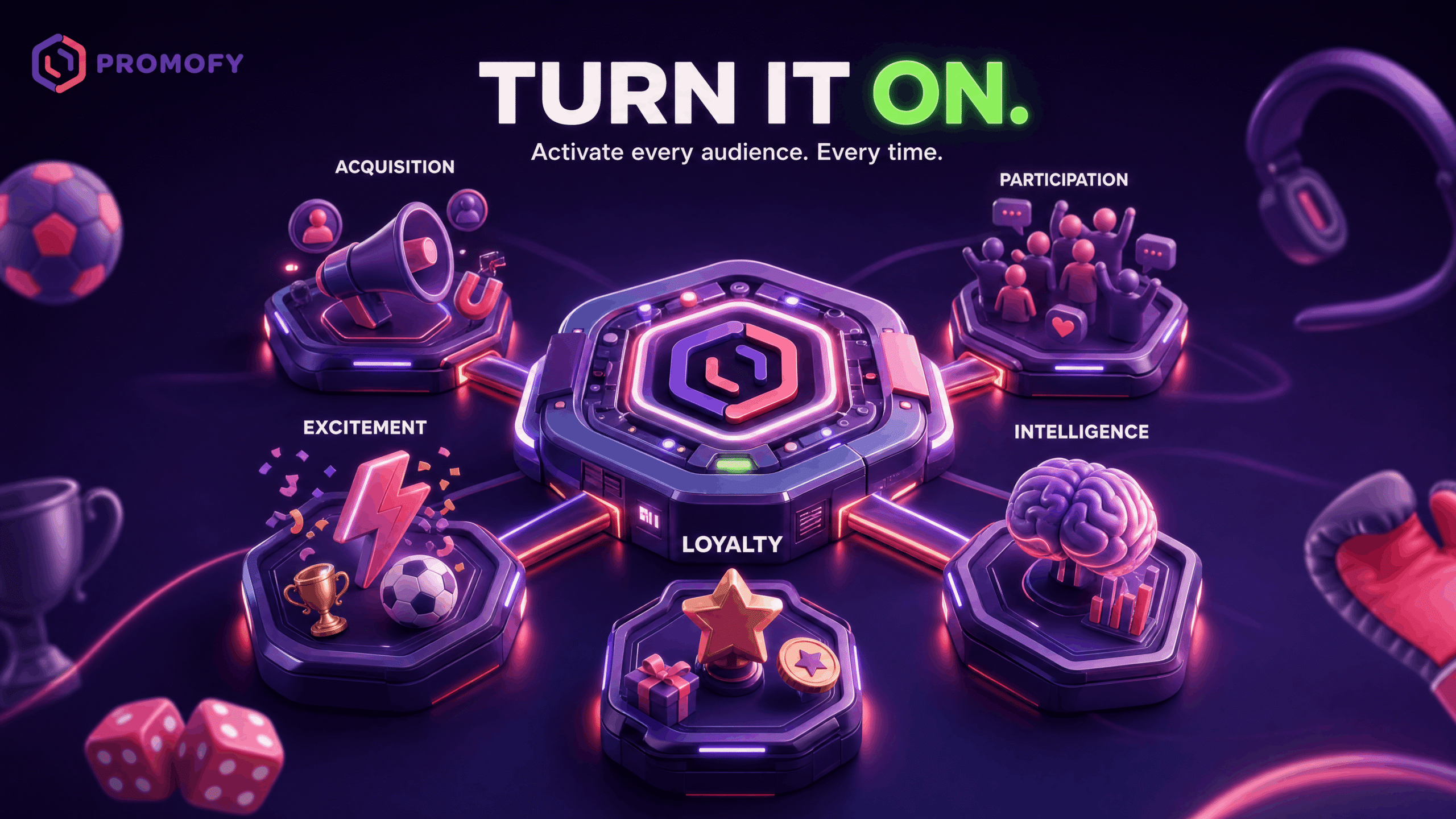
That is the larger logic behind TURN IT ON.
Spark turns acquisition on.
Promofy Gamification turns ongoing participation, progression and retention on.
Promofy Sports Free-to-Play turns sports attention into acquisition, activation and recurring participation.
Progression and loyalty systems keep the relationship moving.
Instead of isolated campaigns, operators can build a connected engagement journey.
What Should Operators Measure?
Spark should not be judged by how many widgets are displayed.
The objective is business performance.
Depending on the campaign, operators can monitor metrics including:
Visitor-to-Registration Rate
Are more high-intent visitors becoming registered players?
Interaction Rate
How many eligible visitors engage with the experience after it appears?
Trigger-to-Conversion Rate
Which behavioral signals create the strongest conversion opportunities?
Registration-to-FTD Rate
Are Spark-acquired registrations progressing toward first deposit?
Cost per Registration
Does improving onsite conversion reduce the effective acquisition cost generated by paid channels?
Cost per FTD
Does the additional conversion layer improve the economics of acquiring depositing players?
Revenue per Acquired Visitor
Ultimately, does more of the traffic already being purchased create measurable commercial value?
Those measurements turn Spark from a creative widget into part of the acquisition optimization stack.
Better Conversion Does Not Mean More Interruption
Behavioral engagement needs control.
Showing every visitor a wheel, offer or Mystery Box would simply create another form of banner blindness.
The stronger model is selective.
Right user.
Right behavior.
Right moment.
Right experience.
Operators also need to align mechanics, incentives, targeting and promotional rules with their market requirements, responsible-gaming policies and internal compliance standards.
The objective is not maximum interaction.
It is relevant interaction.
Turn Existing Traffic Into a Bigger Opportunity
Operators do not necessarily need another acquisition channel.
Sometimes they need to extract more value from the channels they already have.
Affiliates are bringing visitors.
Paid campaigns are bringing visitors.
SEO is bringing visitors.
Sponsorships are bringing visitors.
The question is what happens next.
When a high-intent visitor hesitates, browses, scrolls or begins to leave, the website has a choice.
Do nothing.
Or react.
Promofy Spark creates that second option.
Behavior becomes the trigger.
Interaction becomes the experience.
Conversion becomes the objective.
The traffic is already there.
TURN ACQUISITION ON.
See Promofy Spark in Action
Discover how Promofy Spark can add a real-time behavioral conversion layer to your casino or sportsbook and turn more existing traffic into measurable acquisition opportunities.