Online casinos do not have an engagement problem because they lack bonuses.
They have an engagement problem when players have nothing meaningful to progress toward between individual gaming sessions.
Traditional promotions typically create isolated moments: deposit, receive an incentive, play, leave. Effective casino gamification creates something different—a persistent layer of goals, progression, recognition and rewards around the core casino experience.
That distinction matters.
The strongest casino gamification strategies are not simply collections of wheels, badges and points. They are systems designed to answer four questions for the player:
- What should I do next?
- How far have I progressed?
- What happens when I complete the goal?
- What longer-term objective am I working toward?
For operators, the goal is equally clear: turn isolated player actions into structured engagement journeys that can be measured, segmented and continuously optimized.
This guide examines seven casino gamification strategies operators can use to build those journeys—and, importantly, how to design them without turning gamification into another expensive bonus-distribution channel.
What Is Casino Gamification?
Casino gamification is the application of game-design mechanics around the core gambling experience to create additional layers of progression, achievement, competition, choice and feedback.
Common mechanics include:
- missions and challenges
- points and experience systems
- VIP tiers
- leaderboards
- achievements
- progress bars
- reward shops
- virtual currencies
- streaks
- wheels and randomized rewards
- adventure maps and progression journeys
The distinction between a gamification mechanic and a conventional promotion is important.
A bonus primarily answers:
“What will the operator give me?”
Gamification can answer:
“What am I working toward?”
That shift from isolated reward to visible progression is where gamification becomes strategically useful.
Casino Gamification Should Start With Behaviour, Not Mechanics
A common mistake is selecting a feature first:
We need a leaderboard.
or:
Let’s launch a wheel.
The better approach starts with the player behavior the operator wants to support.
For example:
| Operator objective | Potential gamification mechanic |
|---|---|
| Increase repeat visits | Missions, progression, recurring challenges |
| Increase discovery of casino content | Multi-game missions, collections |
| Strengthen loyalty | XP, levels, VIP progression |
| Create competitive engagement | Leaderboards, tournaments |
| Increase reward flexibility | Virtual currency, reward shop |
| Improve campaign visibility | Progress bars, milestones |
| Reactivate selected players | Personalized challenges |
| Encourage completion of a journey | Multi-stage missions, adventure maps |
Mechanics are therefore not the strategy.
They are the interface through which the strategy becomes visible to the player.
1. Build Persistent Progression With Points and Loyalty Levels
One of the strongest casino gamification strategies is also one of the simplest: give players a visible sense of long-term progression.
Instead of treating every session independently, operators can award experience points, loyalty points or another progression currency for qualifying actions.
Those points can then contribute toward:
- loyalty levels
- VIP tiers
- milestone rewards
- status recognition
- unlockable campaigns
- exclusive experiences
Why progression works
A traditional reward disappears once it has been consumed.
Progress remains.
When a player can see that they are approaching the next level, the experience acquires continuity. Today’s activity becomes connected to tomorrow’s objective.
This is closely related to the goal-gradient principle: motivation can increase as people perceive themselves getting closer to a defined objective.
The important part is therefore not simply awarding points.
Operators need to make progression:
Visible. Understandable. Achievable. Valuable.
A loyalty program where nobody understands how points are earned or what the next level provides is not meaningful gamification.
Operator example
Instead of:
Wager €100 and receive a reward.
The journey could be structured as:
Bronze → Silver → Gold → Platinum
with each tier introducing new benefits, campaigns or experiences.
The immediate incentive becomes part of a broader progression system rather than an isolated transaction.
What to measure
Operators should monitor:
- progression participation rate
- average progression velocity
- percentage of players reaching each tier
- active days between tier changes
- retention by tier
- reward cost by progression stage
- drop-off points within the loyalty journey
The objective is not simply to move everyone upward faster.
It is to understand whether progression creates meaningful incremental engagement.
2. Turn Player Activity Into Missions and Challenges
Missions are one of the most flexible casino gamification mechanics because they turn ordinary player activity into defined objectives.
A mission could involve:
- playing selected games
- completing several different activities
- reaching a qualifying milestone
- participating on multiple days
- collecting specific achievements
- completing a sequence of tasks
But effective mission design goes beyond:
Do X and receive Y.
The strongest systems introduce structure.
For example:
Mission 1 → Mission 2 → Mission 3 → Final Reward
or:
Daily Challenge → Weekly Completion → Monthly Progression
This creates a reason for the player to understand not only the immediate action but the larger journey.
The psychology of visible completion
Missions work particularly well when three elements are clear:
Goal: What do I need to accomplish?
Progress: How close am I?
Outcome: What happens when I finish?
Remove any one of those and engagement can weaken.
A poorly designed challenge with ambiguous requirements creates friction.
A well-designed mission reduces uncertainty.
Casino mission example
An operator could create a five-stage content-discovery campaign:
- Participate in one qualifying slot category
- Explore a second eligible category
- Complete an additional qualifying activity
- Reach a defined campaign milestone
- Unlock the final campaign reward
The commercial objective might be content discovery.
The player sees a journey.
That distinction is what good gamification design achieves.
What to measure
Track metrics such as:
- mission participation rate
- mission completion rate
- time to completion
- step-by-step abandonment
- incremental active days
- reward redemption
- cost per completed mission
- performance by player segment
If 70% of players complete stages one and two but only 15% reach stage three, the mission design is giving the operator actionable information.
Gamification should create measurable behavioral signals—not merely attractive interfaces.
3. Use Leaderboards to Create Structured Competition
Leaderboards add a social and competitive dimension to casino engagement.
But simply ranking every customer according to total wagering is rarely the most sophisticated implementation.
Different leaderboard structures can support different operator objectives.
Examples include:
- highest multiplier
- qualifying wins
- accumulated points
- mission completions
- selected-game performance
- tournament scores
- segmented competition
- VIP-specific competition
- regional competition
Why segmentation matters
Imagine a casual player opening a leaderboard and seeing that first place is effectively unreachable.
The competitive loop is over before it begins.
Instead, operators can create smaller or segmented competitions where more participants perceive that advancement is possible.
For example:
Bronze leaderboard
Silver leaderboard
Gold leaderboard
or segmented tournaments based on predefined player groups.
This turns competition from an exclusive experience into a broader engagement mechanic.
Real-time feedback matters
If leaderboard positions only update periodically, the connection between the player’s action and its consequence becomes weaker.
A modern gamification architecture should therefore be able to receive qualifying player events, calculate progression and reflect changes quickly enough that the experience feels connected.
The engagement loop becomes:
Player action → event → score update → visible ranking → next decision
That is fundamentally different from running a spreadsheet-based tournament and publishing results later.
What to measure
Operators should evaluate:
- tournament participation rate
- percentage of participants who return
- leaderboard movement
- activity distribution across ranking positions
- prize-pool efficiency
- engagement by segment
- incremental activity compared with control cohorts
The objective is not to make players wager as much as possible.
It is to determine whether competition creates a commercially sustainable and responsibly designed engagement experience.
4. Use Randomized Rewards Carefully
Wheels, mystery rewards and randomized promotional mechanics can create moments of anticipation and surprise within a broader engagement system.
But randomness alone is not a strategy.
A wheel shown to every player after every login quickly becomes another piece of interface furniture.
The mechanic becomes more meaningful when it is connected to progression.
For example:
Complete mission → earn token → unlock wheel
or:
Reach loyalty milestone → unlock mystery reward
or:
Complete campaign stage → reveal reward
Now the randomized component acts as the payoff to a defined journey.
The important design principle
The surprise should complement progression—not replace it.
Operators should control:
- eligibility
- frequency
- reward inventory
- probability
- campaign duration
- player segments
- maximum reward exposure
And in regulated markets, the mechanic must also fit the operator’s licensing, promotion, responsible-gaming and incentive requirements.
Gamification technology should give teams more control over reward logic, not less.
5. Use Achievements and Streaks to Make Progress Visible
Not every gamification reward needs to have monetary value.
Achievements can recognize player milestones through:
- badges
- collections
- status markers
- completed challenges
- campaign trophies
- progression records
- unlockable visual items
These mechanics are particularly useful because they allow operators to recognize activity without making every engagement moment dependent on free spins, cashback or bonus money.
Streaks require more careful design
A streak represents consecutive participation.
For example:
Day 1 → Day 2 → Day 3 → Day 4
The psychological benefit is continuity: previous activity contributes to a visible sequence.
However, regulated operators need to think carefully about what behavior a streak encourages.
A system designed simply to maximize gambling frequency can create responsible-gaming concerns.
A better approach is to use streak-like progression selectively and ensure mechanics operate within the operator’s player-protection framework.
In the UK, for example, remote operators are required to implement systems that identify indicators of gambling harm, act appropriately and evaluate outcomes. Marketing and new bonus offers must also be prevented where strong indicators of harm have been identified.
Gamification therefore cannot operate as an isolated engagement layer.
It should respect the same player states, exclusions and responsible-gaming decisions that govern CRM and promotional activity.
6. Create Reward Choice With Virtual Currency and Reward Shops
Traditional casino promotions often decide the reward on the player’s behalf.
A reward shop can invert that relationship.
Players earn a virtual currency through qualifying gamified activities and decide how to redeem it from an operator-defined catalogue.
Potential options could include:
- promotional rewards
- eligible free spins
- cashback
- campaign entries
- non-monetary rewards
- exclusive experiences
- digital status items
Why reward choice matters
Two players with similar activity may value entirely different rewards.
Giving the player controlled choice can increase the perceived relevance of the reward while allowing the operator to manage the underlying reward economy.
But building a virtual currency system introduces an important new responsibility:
The operator must manage the economy.
Questions include:
- How quickly is currency earned?
- Where is currency issued?
- What is its effective cost?
- How much remains unredeemed?
- Which rewards create the best engagement?
- Are some rewards disproportionately expensive?
- Do high-value segments use the shop differently?
- Does currency accumulate too easily?
This moves gamification beyond campaign creation and into engagement economics.
What to measure
Track:
- currency issued
- currency redeemed
- redemption rate
- average balance
- reward selection distribution
- cost per redeemed reward
- engagement after redemption
- breakage
- incremental value relative to reward cost
A reward shop is most valuable when operators can understand its economics—not simply when it looks attractive.
7. Make Progress Visible Everywhere
The final strategy sounds simple, but it affects almost every other mechanic:
show the player what is happening.
Progress can be represented through:
- progress bars
- mission counters
- completion percentages
- XP meters
- level indicators
- collection states
- leaderboard movement
- countdowns
- unlocked milestones
Without feedback, the player performs an action.
With feedback, the player understands its consequence.
Consider the difference between:
Mission active.
and:
3 of 5 objectives complete — 2 remaining.
The second version transforms an invisible rule into a visible goal.
Real-time event architecture makes this stronger
This is where gamification becomes an infrastructure question rather than purely a creative one.
A simplified flow can look like:
Player Action
↓
Casino / PAM Event
↓
CRM or Player Data
↓
Gamification Logic
↓
Mission / Progress / Leaderboard Update
↓
Player Interface
↓
Analytics
The closer these components operate to the player event, the more naturally the system can reflect what just happened.
That creates a much stronger engagement experience than relying exclusively on delayed batch campaigns.
Casino Gamification Is an Operating System, Not a Collection of Widgets
The seven mechanics above become more powerful when they work together.
Consider this journey:
Player joins campaign
↓
Completes first mission
↓
Earns XP
↓
Moves toward loyalty level
↓
Receives virtual currency
↓
Redeems chosen reward
↓
Appears on segmented leaderboard
↓
Unlocks next mission
Now the operator is no longer running seven disconnected promotions.
It is running a persistent engagement system.
That is the real strategic opportunity behind casino gamification.
How Should Operators Measure Casino Gamification?
One of the biggest mistakes is evaluating gamification using only participation.
A campaign with thousands of participants is not necessarily commercially successful.
Operators need to distinguish between:
Activity metrics
- campaign views
- participants
- mission completions
- leaderboard entries
- reward redemptions
and:
Business metrics
- incremental active days
- retention
- reactivation
- deposit frequency
- cross-content discovery
- campaign cost
- reward cost
- player value
- incremental revenue
- churn
Where possible, operators should compare gamified cohorts with appropriate control groups.
The central question is not:
Did players use the mechanic?
It is:
Did the mechanic change the targeted behavior enough to justify its cost?
That is how casino gamification moves from a creative initiative to a measurable retention capability.
Responsible Gamification Needs to Be Built Into the Architecture
Engagement and player protection should not be separate systems.
A modern casino gamification strategy needs to respect:
- responsible-gaming exclusions
- marketing permissions
- player-risk states
- jurisdictional restrictions
- reward eligibility
- promotional rules
- player segmentation
- campaign limits
This becomes increasingly important as regulators place more attention on how incentives and player interactions are designed.
For UK-licensed operators, for example, current Gambling Commission rules require incentive terms to be clear, transparent and fair. From January 19, 2026, wagering requirements on bonus funds are capped at 10x and incentives cannot combine multiple gambling product categories.
The Commission also requires remote licensees to prevent targeted marketing and new bonus offers when strong indicators of gambling harm are identified.
The implication for gamification teams is straightforward:
real-time engagement should also support real-time restraint.
An engagement engine should be capable of knowing not only when a player qualifies for an experience, but also when that experience should not be shown.
Choosing the Right Casino Gamification Strategy
Different mechanics solve different problems.
| If your objective is… | Consider… |
| Build long-term progression | XP, tiers, loyalty |
| Increase repeat campaign participation | Missions |
| Encourage competition | Leaderboards |
| Add reward anticipation | Wheels or mystery rewards |
| Recognize milestones | Achievements |
| Increase reward choice | Virtual currency + reward shop |
| Improve campaign clarity | Progress visualization |
| Build complex player journeys | Multi-stage missions + progression |
The best operators will rarely use only one mechanic.
They will combine mechanics into journeys built around specific player segments and measurable objectives.
Where Promofy Fits
Promofy is built as a modular gamification and engagement layer for online casinos and sportsbooks.
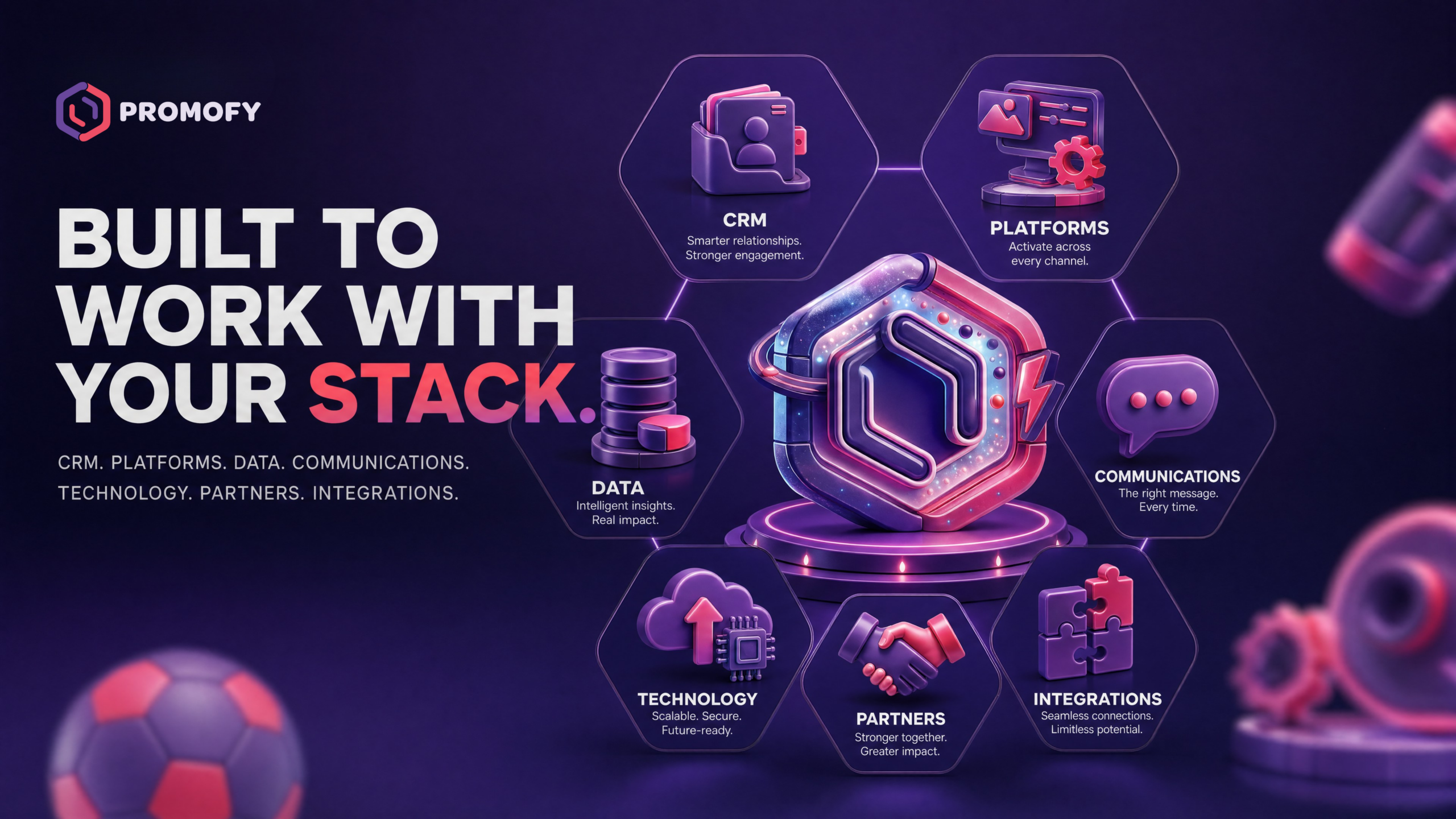
Rather than requiring operators to replace their CRM or existing technology stack, Promofy can connect gamification mechanics with the systems already generating player data and campaign decisions.
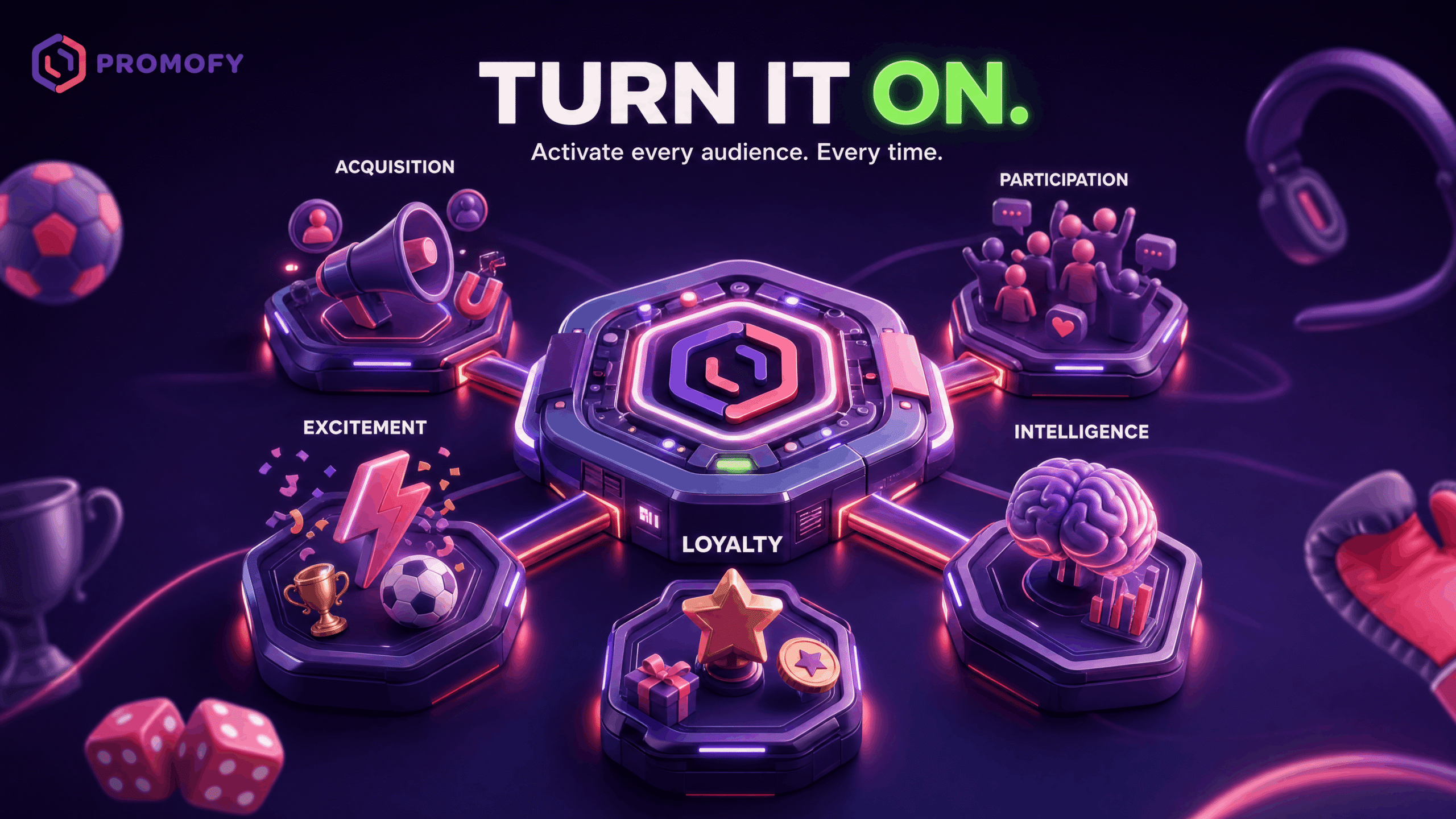
Operators can use Promofy to build experiences around mechanics including:
- missions and challenges
- loyalty progression
- leaderboards
- reward systems
- virtual currencies
- reward shops
- wheels
- adventure-style progression
- Free-to-Play experiences
The important distinction is that these mechanics can operate as components of a broader engagement architecture rather than isolated promotions.
Player activity can trigger progress, eligibility, rewards and experiences according to campaign logic while operator teams retain control over segmentation and implementation.
Casino Gamification Strategy FAQ
What is the best gamification strategy for an online casino?
There is no single best mechanic. The right strategy depends on the behavior an operator wants to influence. Missions are effective for structured objectives, progression systems support longer-term loyalty, leaderboards introduce competition, and reward shops provide player choice. The strongest approach often combines several mechanics into one measurable journey.
How does gamification improve casino player retention?
Gamification can give players additional goals, visible progression and continuity between sessions. Instead of interacting only with individual promotions, players can progress through missions, levels, achievements or loyalty journeys that persist over time. Operators should measure whether these mechanics produce incremental retention rather than assuming participation automatically equals retention.
Can gamification work with an existing casino CRM?
Yes. A gamification platform can operate as an engagement layer connected to an existing CRM, PAM or player-data environment. CRM systems can continue handling segmentation and communication while the gamification layer manages player-facing progression, missions and reward experiences.
What casino gamification mechanics are most commonly used?
Common mechanics include missions, points, loyalty levels, VIP progression, leaderboards, tournaments, achievements, progress bars, virtual currencies, reward shops, wheels, randomized rewards and multi-stage journeys.
How should operators measure gamification ROI?
Operators should go beyond campaign participation and track metrics such as incremental active days, retention, mission completion, reward cost, redemption, reactivation, player value and incremental revenue. Controlled cohort comparisons can help determine whether observed changes were actually caused by the gamified experience.
Is casino gamification compatible with responsible gambling requirements?
It can be, but implementation matters. Gamification campaigns should operate within the same responsible-gaming, marketing-permission, player-risk and jurisdictional controls used elsewhere in the operator’s technology stack. Eligibility and suppression rules should be considered part of the gamification architecture itself.
From Promotions to Persistent Player Journeys
Casino gamification is moving beyond individual promotional widgets.
The more important opportunity is building a persistent engagement layer where players can see what they have achieved, understand what comes next and progress through experiences that extend beyond a single campaign.
That requires more than attractive mechanics.
It requires:
real-time data, clear progression, controlled reward logic, meaningful segmentation, measurable economics and responsible implementation.
When those components work together, missions, leaderboards, loyalty, virtual currencies and rewards stop being disconnected features.
They become an engagement system.
Promofy gives iGaming operators the infrastructure to build those systems around their existing CRM and technology stack.
Explore Promofy’s gamification capabilities or book a demo to map your next casino engagement journey.