Sportsbooks do not have an engagement problem because players lack things to bet on.
They have an engagement problem because the traditional sportsbook experience gives players relatively few reasons to interact between bets.
A player opens the sportsbook, checks the markets, places a bet and waits for the result. Once the transaction is complete, much of the interaction stops.
Gamification in sports betting changes that journey.
Missions, challenges, leaderboards, prediction games, progression systems and personalized rewards introduce additional reasons for players to participate before, during and after sporting events.
For operators, the opportunity is bigger than making a sportsbook feel more entertaining.
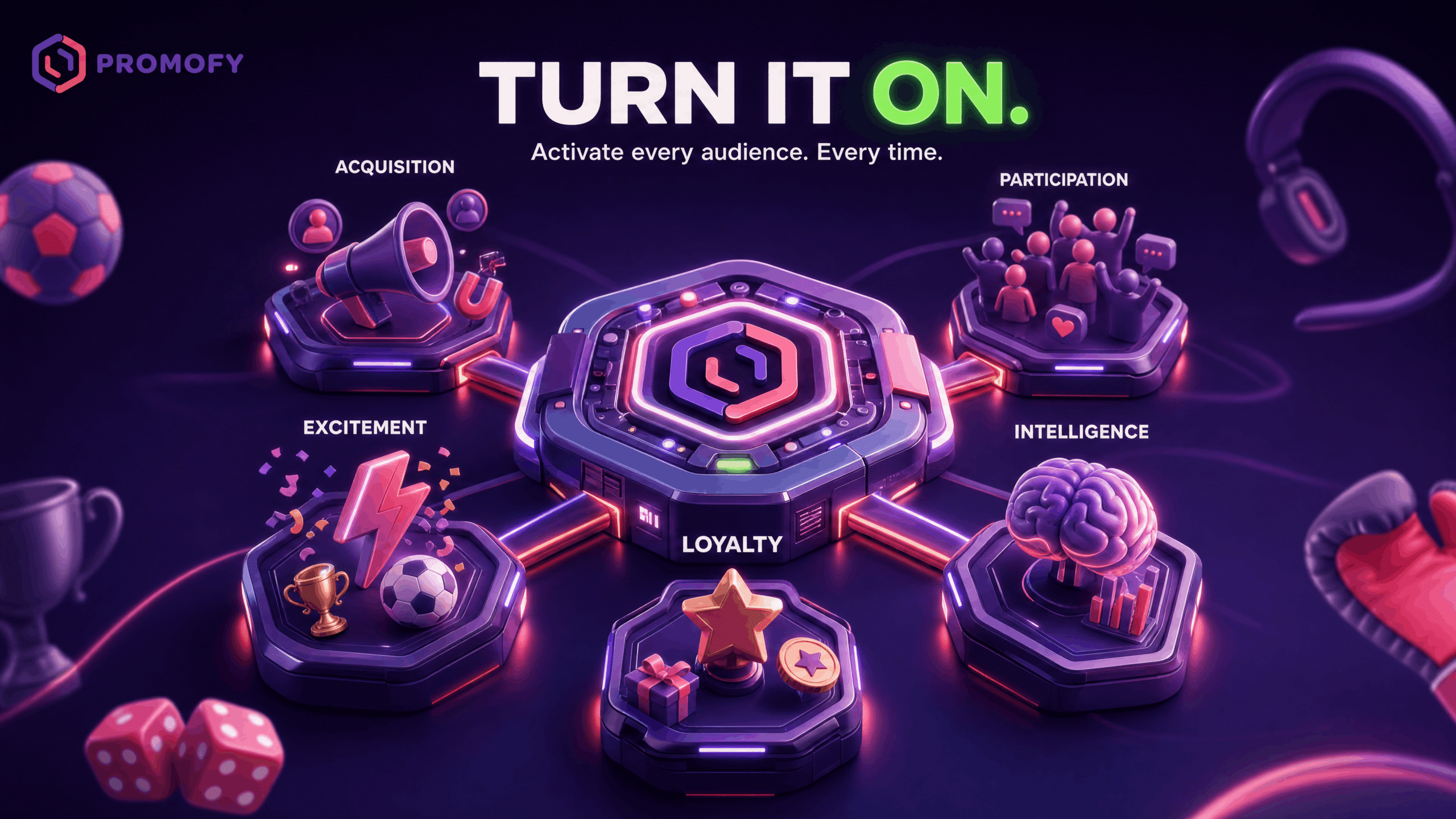
Done correctly, gamification can become an engagement layer connecting acquisition, activation, retention and loyalty across the player lifecycle.
What Is Gamification in Sports Betting?
Gamification in sports betting means applying game mechanics and interactive experiences to the sportsbook journey.
Instead of engagement depending entirely on placing another wager, operators can create additional actions, objectives and progression loops around the sports experience.
These can include:
- missions and challenges;
- points and progression systems;
- leaderboards;
- badges and achievements;
- prediction games;
- tournaments;
- reward mechanics;
- personalized challenges;
- streaks and milestones;
- free-to-play sports experiences.
The important distinction is that effective sportsbook gamification is not simply a collection of visual features.
Every mechanic should have a purpose.
A mission might encourage a player to explore a particular event. A prediction game can create an acquisition opportunity before a major tournament. A leaderboard can build competition across a campaign. A progression system can give returning players a visible reason to continue participating.
That is where gamification starts becoming commercially useful.
Why Sportsbooks Are Turning to Gamification
Sports betting is already competitive by nature.
Fans follow teams, predict results, debate outcomes and compare their knowledge with other supporters. Gamification builds on behaviours that already exist around sport.
For operators, this creates an opportunity to expand the relationship beyond odds and promotions.
Instead of asking only:
“What can the player bet on next?”
operators can also ask:
“What can the player do next?”
That difference matters.
When a sportsbook creates more meaningful actions across the customer journey, it creates more opportunities to communicate, reward, personalize and re-engage.
A player might complete a matchday challenge, move up a leaderboard, unlock the next mission or return to maintain their progress.
The sportsbook becomes less transactional and more interactive.
How Gamification Increases Sports Betting Engagement
The strongest gamification strategies create engagement loops.
An action produces progress. Progress creates feedback. Feedback introduces another objective. The next objective creates a reason to return.
Missions Give Players Clear Objectives
Missions transform ordinary sportsbook actions into structured journeys.
Instead of navigating the platform without direction, players can receive clear objectives connected to campaigns, sports, competitions or specific events.
For example, an operator could create a football weekend mission that encourages users to complete several actions across selected matches.
The value of the mission is not simply the reward at the end.
It creates a visible objective and gives the player a reason to continue interacting with the sportsbook.
Progression Makes Engagement Visible
Progress bars, levels, milestones and achievements answer an important question:
How far have I come?
Without progression, many sportsbook interactions exist independently.
With progression, those interactions can become part of a larger journey.
Players can see what they have completed, what they have unlocked and what remains available.
This turns individual interactions into an ongoing experience.
Leaderboards Add Competition
Sport is inherently competitive, which makes leaderboards particularly relevant for sportsbook engagement.
Players can compete around predictions, challenges, points or campaign-specific activities.
A leaderboard creates something that a standard promotion often cannot: changing status.
The player’s position can move.
That creates another reason to check the platform even when the player is not immediately looking to place another bet.
Leaderboards can also be designed around individual events, tournaments, leagues or longer seasonal campaigns, giving operators considerable flexibility.
Rewards Reinforce the Right Moments
Rewards are most effective when they reinforce meaningful behaviour rather than appearing randomly.
A reward can recognize:
- completing a mission;
- reaching a milestone;
- participating in a campaign;
- maintaining a streak;
- achieving a leaderboard position;
- completing a prediction challenge.
The objective is not simply to distribute more incentives.
It is to connect rewards with actions operators want to encourage and moments players understand.
That connection makes the experience feel more intentional.
From Engagement to Retention
Gamification becomes especially valuable when it gives players a reason to return.
Traditional promotions can create short bursts of activity. Once the promotion ends, however, the engagement loop often disappears with it.
Progressive gamification can operate differently.
A player may return because a mission is unfinished.
Another may want to improve their leaderboard position.
Someone else may be approaching the next level or waiting for the next stage of a tournament challenge.
Each creates continuity between sessions.
That continuity is fundamental to retention.
Instead of every visit beginning from zero, previous interactions influence what the player sees and what they can accomplish next.
The sportsbook starts building an ongoing journey.
Personalization Makes Gamification More Relevant
Not every player should receive the same experience.
A football-focused user and a basketball-focused user may respond to completely different missions. A highly engaged player may require a different challenge from someone who has recently become inactive.
This is where personalization becomes increasingly important.
Operators can use player behaviour, preferences and lifecycle stages to determine which experiences are most relevant.
That can influence:
- which missions are presented;
- which sports or events are highlighted;
- which rewards are available;
- when challenges appear;
- how difficult objectives become;
- which players receive specific re-engagement experiences.
The goal is to move away from one campaign for the entire database toward experiences that respond to individual players.
Gamification provides the mechanics.
Personalization determines when and how those mechanics should be used.
Free-to-Play Games Can Extend the Sportsbook Funnel
Gamification does not have to begin after registration or deposit.
Free-to-play sports experiences can sit much earlier in the acquisition journey.
Prediction games, pick’em contests, tournament brackets and other interactive formats allow fans to participate without immediately requiring a traditional betting action.
For operators, this creates another entry point into the customer journey.
A major tournament, for example, can become more than a sequence of promotional campaigns. Operators can build an interactive experience around the entire competition, encouraging users to predict results, accumulate points and return throughout the event.
That engagement can create opportunities to acquire first-party data, activate audiences and introduce relevant sportsbook experiences over time.
Free-to-play therefore connects acquisition and gamification rather than treating them as separate strategies.
Real-Time Gamification Matters
Timing is one of the most important parts of a gamified experience.
If a player completes an objective, they should understand that it happened.
If they move up a leaderboard, the experience should reflect it.
If they unlock a reward or complete a challenge, feedback should arrive while the action is still relevant.
That requires the gamification layer to respond to player behaviour and event data quickly.
Real-time triggers can support experiences based on actions such as:
- completing a mission;
- reaching a milestone;
- changing leaderboard position;
- interacting with a specific event;
- completing a prediction;
- unlocking a reward.
The closer the feedback is to the player’s action, the stronger the connection between behaviour and outcome becomes.
Gamification therefore depends not only on creative campaign design but also on the infrastructure behind the experience.
Gamification Should Support Responsible Play
More engagement should not mean encouraging uncontrolled betting behaviour.
Sportsbook gamification should be designed within the operator’s responsible gaming framework and applicable regulatory requirements.
That means operators need to think carefully about which behaviours are rewarded, how challenges are structured and how engagement mechanics interact with player protection systems.
Gamification can also be applied to positive behaviours.
Progress mechanics, educational challenges and interactive experiences can help make responsible gaming information more visible and understandable.
The objective should be sustainable engagement—not engagement at any cost.
What Makes a Strong Sports Betting Gamification Strategy?
The most effective gamification strategies begin with a business objective rather than a mechanic.
Do not start with:
“We need a leaderboard.”
Start with:
“What behaviour are we trying to influence?”
If the objective is acquisition, a free-to-play prediction experience may make sense.
If the objective is activation, onboarding missions could help players discover relevant parts of the sportsbook.
If the objective is retention, progression systems, recurring challenges and personalized missions may be more appropriate.
If the objective is reactivation, behaviour-triggered campaigns can introduce a reason to return.
The mechanic should follow the objective.
Operators should therefore think about gamification across several dimensions:
Business goal → Player segment → Trigger → Experience → Reward → Next action
When these pieces work together, gamification becomes part of the customer journey rather than an isolated campaign.
The Future of Gamification in Sports Betting
The next stage of sportsbook gamification will be less about adding more mechanics and more about making those mechanics smarter.
AI, behavioural data and real-time decisioning are creating opportunities for increasingly adaptive customer journeys.
Instead of every player receiving the same mission at the same moment, systems can determine which experience is appropriate based on context.
One player might receive a football challenge.
Another might enter a prediction experience around an upcoming basketball game.
A third might see a personalized progression objective based on previous activity.
The underlying shift is from static gamification to intelligent gamification.
That is where the biggest opportunity lies.
The sportsbook of the future will not simply contain missions, leaderboards and rewards.
It will increasingly decide which experience to activate, for which player and at which moment.
Turning Sports Betting Into an Ongoing Experience
Gamification in sports betting is ultimately about creating more reasons for players to participate.
Missions provide objectives.
Progression provides momentum.
Leaderboards introduce competition.
Rewards reinforce meaningful actions.
Free-to-play games expand the acquisition journey.
Personalization makes experiences relevant.
Real-time interaction connects player behaviour with immediate feedback.
Together, these mechanics can transform a sportsbook from a primarily transactional environment into an ongoing engagement ecosystem.
For operators, that means gamification should not be treated as another promotional feature.
It can become infrastructure for building stronger relationships across acquisition, engagement, retention and loyalty.
Promofy helps operators build and manage gamified customer journeys across sports betting and iGaming—from missions, tournaments and leaderboards to free-to-play sports experiences, rewards and personalized engagement.
The opportunity is not simply to make betting more entertaining.
It is to give every player a meaningful reason to take the next action.