Getting visitors to your online casino is only half the challenge.
Operators invest in paid advertising, affiliate partnerships, SEO, sponsorships, and brand awareness. Yet even when those channels generate relevant traffic, a significant opportunity can disappear before a visitor creates an account.
A player lands on the website. Explores the games. Checks the promotions. Maybe even clicks the registration button.
Then leaves.
No registration. No first deposit. No opportunity to build a long-term relationship.
The problem is not always traffic quality. Often, it is what happens between the first visit and the registration decision.
This is where casino conversion rate optimization (CRO) becomes critical.
For iGaming operators, improving conversion requires more than shortening registration forms or offering bigger bonuses. It means understanding why visitors hesitate, removing unnecessary friction, and creating relevant experiences that help eligible players make informed decisions.
Here are seven common reasons visitors abandon online casinos before registering—and what operators can do to address them.
What Is Casino Conversion Rate Optimization?
Casino conversion rate optimization is the process of improving the percentage of eligible website visitors who complete a desired action, such as starting registration, creating an account, completing verification, or making a first deposit.
For online casinos, the acquisition journey typically follows several stages:
Website Visit → Engagement → Registration Start → Registration Completion → Verification → First Deposit → Activation
The exact sequence varies by market and regulatory requirements.
Each transition presents a potential point of friction.
A visitor might be interested in the casino but uncertain about its credibility. Another may like the promotional offer but abandon a complicated registration form. Someone else might browse several pages without finding a compelling reason to create an account.
These are different problems requiring different solutions.
Measuring only total registrations or first-time deposits can hide the issues occurring earlier in the journey.
The goal of effective iGaming CRO is to identify where visitors disengage, understand why, and improve the experience without compromising regulatory obligations or player protection.
1. Your Landing Page Doesn’t Match What Brought Visitors There
Imagine someone clicks an affiliate promotion advertising a specific casino offer.
They arrive on the operator’s homepage, where the main banner promotes something completely different.
The offer they expected is difficult to find. The next action is unclear. They have to navigate through several pages to understand what they originally clicked.
The visitor may leave before reaching registration.
This is a message-match problem.
When the expectations created by an advertisement, search result, or affiliate placement do not align with the landing page, the visitor has to work harder to understand the proposition.
How operators can fix it
Create landing experiences that reflect the acquisition source and visitor’s likely intent.
For example:
- Direct visitors from game-specific campaigns to relevant game or category pages.
- Ensure promotional landing pages accurately reflect the advertised offer.
- Localize language, currency, and eligible promotions for the relevant market.
- Make the primary registration CTA easy to identify.
- Keep important offer information visible without requiring unnecessary navigation.
The objective is not to create a separate website for every acquisition channel.
It is to provide continuity between the message that generated interest and the experience that follows.
What to measure: Registration-start rate by traffic source, campaign, landing page, device, and market.
If one acquisition campaign consistently generates visitors who leave before starting registration, investigate the landing experience before increasing acquisition spend.
2. Visitors Don’t Trust the Casino Enough to Create an Account
Registration requires a visitor to share personal information.
Depending on the market and verification requirements, that may include identity details, contact information, and documentation.
Before providing those details, visitors need confidence in the platform.
An unfamiliar casino brand can create hesitation if the website lacks transparent information about its legitimacy, operating conditions, customer support, or data protection practices.
This becomes especially important when traffic comes from affiliates or promotional campaigns rather than established brand recognition.
What creates trust before registration?
Operators should make important information accessible and understandable.
This includes:
- Accurate licensing and regulatory information.
- Clear information about the operating company.
- Accessible customer support and contact details.
- Transparent payment and withdrawal policies.
- Readable terms and conditions.
- Appropriate security and privacy information.
- Visible responsible-gambling resources.
Trust also depends on consistency.
A polished advertisement leading to a confusing or outdated registration page can undermine confidence.
Similarly, aggressive promotional messaging combined with unclear conditions may make visitors question the offer.
How operators can fix it
Audit the experience from the perspective of someone encountering the brand for the first time.
Can visitors establish who operates the casino?
Can they understand the essential conditions?
Can they find information about how personal data is handled?
Can they access assistance before registering?
These questions matter because registration is not simply a conversion event.
It is a decision to begin a relationship with an operator.
What to measure: Landing-to-registration-start conversion, interactions with trust and information pages, and qualitative feedback from user testing.
3. The Mobile Experience Creates Too Much Friction
Casino acquisition often involves visitors switching between advertising, mobile browsers, affiliate pages, and operator websites.
That makes the mobile experience an essential part of conversion optimization.
A website can look impressive on desktop while creating serious friction on a smaller screen.
Common issues include:
- Heavy banners delaying visible content.
- Registration buttons hidden beneath promotional elements.
- Pop-ups obstructing navigation.
- Forms that are difficult to complete using a mobile keyboard.
- Unresponsive buttons or slow interactions.
- Unexpected layout shifts.
- Verification processes that are difficult to complete on mobile.
A visitor may be interested enough to register but unwilling to navigate a frustrating interface.
How operators can fix it
Start by measuring real user performance rather than evaluating the website only on a fast office connection.
Google’s Core Web Vitals provide useful benchmarks for loading, responsiveness, and visual stability, including a target Largest Contentful Paint of 2.5 seconds or less.
However, mobile CRO also requires practical usability testing.
Operators should test the complete journey on different screen sizes, devices, and connection conditions.
Pay particular attention to the registration button, keyboard behavior, form validation, and transitions between registration and verification.
Optimize for the next action
Every major screen should make the next step understandable.
Visitors should not need to close multiple overlays, search for a registration button, or repeatedly enter information to continue.
What to measure: Mobile registration-start rate, form completion rate, page performance, interaction errors, and abandonment by device.
The objective is not merely a faster website.
It is a smoother path from visitor interest to account creation.
4. The Registration Form Asks for Too Much, Too Early
A registration form is often the first major commitment in the acquisition journey.
Yet some operators make that commitment unnecessarily difficult.
Multiple screens, unclear validation rules, repetitive fields, and avoidable errors increase the work required to create an account.
A visitor who was ready to register may abandon the process after encountering repeated obstacles.
Research from the Baymard Institute on ecommerce checkout usability shows how unnecessary form complexity can contribute to abandonment. Although ecommerce checkout is not identical to regulated casino registration, the underlying usability principles provide a useful starting point.
How operators can fix it
Review every field in the registration flow.
Ask whether the information is required at that stage for legal, security, operational, or product reasons.
Remove genuinely unnecessary fields, but preserve mandatory identity, age-verification, and other regulatory requirements.
Practical improvements include:
- Clear labels and understandable instructions.
- Appropriate autofill support.
- Inline validation that explains how to correct errors.
- Visible password requirements before submission.
- Progress indicators for multi-step registration.
- Preservation of entered information when a recoverable error occurs.
- Accessible controls and mobile-friendly input types.
Avoid adding optional marketing questions simply because the visitor is already completing a form.
Separate unnecessary friction from required compliance
Shorter is not automatically better.
Operators need to distinguish between unnecessary UX complexity and information that must legally be obtained or verified.
The goal is to make required steps easier to understand and complete—not to remove safeguards.
What to measure: Registration-start-to-completion rate, abandonment by form step, validation error frequency, and median completion time.
5. Identity Verification Comes as an Unpleasant Surprise
Identity verification is part of operating a compliant online casino.
However, the way the requirement is communicated can significantly affect the registration experience.
Imagine reaching the end of a registration process only to discover that additional information or documentation is required, with no explanation of what happens next.
Even when the verification process is legitimate, unclear expectations can cause hesitation.
For example, Great Britain’s Gambling Commission requires relevant remote operators to establish and verify customer identity before permitting gambling.
The requirement is not optional.
Casino CRO must improve the experience around verification without bypassing legally required checks.
How operators can fix it
Explain the process before visitors encounter it.
Where appropriate, communicate:
- What information will be requested.
- Why verification is necessary.
- Which documents may be accepted.
- What the next verification step involves.
- What happens if automatic verification is unsuccessful.
- How users can access support.
Use clear status messages to distinguish between a request being submitted, pending verification, and successfully approved.
Where legally permitted, reduce duplicate data entry and support appropriate electronic verification methods.
Do not promise immediate verification unless the operator can reliably deliver it.
The conversion opportunity
The objective is to reduce uncertainty.
When visitors understand why information is needed and how the process works, the required compliance journey can feel more predictable.
What to measure: Verification initiation rate, successful completion rate, abandonment by step, verification-related support contacts, and time to resolution.
6. Your Welcome Offer Creates Confusion Instead of Value
Promotions can attract attention.
But an attractive headline does not automatically build trust or create a reason to register.
Consider a visitor who sees a prominent welcome offer but cannot quickly understand its eligibility, restrictions, or essential conditions.
The offer may attract the initial click while failing to support an informed registration decision.
For operators, the solution is not necessarily making the promotion bigger.
It is making the value proposition clearer.
Why clarity matters
Visitors should be able to understand the essential details of a promotion before committing.
Depending on the offer and jurisdiction, those details may include:
- Who is eligible.
- Minimum qualifying requirements.
- Applicable wagering conditions.
- Relevant game restrictions.
- Offer validity and expiration.
- Any important withdrawal or reward limitations.
Promotional claims and disclosures should be consistent throughout advertising, landing pages, and registration.
In regulated markets, fair and transparent promotional terms are also a compliance requirement, not simply a UX preference.
How operators can fix it
Make the offer understandable without requiring visitors to search through several pages of legal text.
Present key conditions prominently, and provide accessible links to complete terms.
Then test whether the communication genuinely helps visitors understand the offer.
For example, operators can compare a generic promotional banner with a clearer presentation that explains eligibility and the relevant conditions.
The goal should be informed registrations—not simply additional clicks on an attractive headline.
What to measure: Qualified registration rate by campaign, offer-page engagement, promotion-related support queries, and downstream activation among eligible users.
7. Visitors Show Interest, but Nothing Happens Before They Leave
This is one of the most interesting opportunities in modern casino conversion rate optimization.
Most acquisition strategies are designed around a familiar process:
Acquire Traffic → Show Landing Page → Display Registration CTA → Hope Visitors Convert
But the visitor journey is rarely that straightforward.
Someone may spend time reviewing games, scroll through a promotion, return to the same page, or interact with a registration button without completing the process.
Those actions can provide useful behavioral context.
Yet many websites respond to every visitor with the same static experience.
The result is a missed opportunity to make the next action more relevant.
From passive traffic to interactive engagement
Instead of relying entirely on traditional banners, operators can introduce contextual onsite experiences for eligible visitors.
Examples include:
- A relevant interactive experience after meaningful engagement with a campaign page.
- A targeted banner that helps visitors discover an offer they have already shown interest in.
- A scratch card or spin wheel attached to a clearly explained, compliant promotion.
- A contextual invitation after a visitor interacts with a specific CTA.
- An experience triggered by a relevant exit signal, where supported.
These mechanics should not be used indiscriminately.
An immediate pop-up can be just as disruptive as a poorly designed registration form.
The important distinction is between interrupting a visitor and responding to meaningful context.
How Promofy Spark addresses this challenge
Promofy Spark is designed specifically for the acquisition stage—before a visitor enters the traditional registered-player lifecycle.
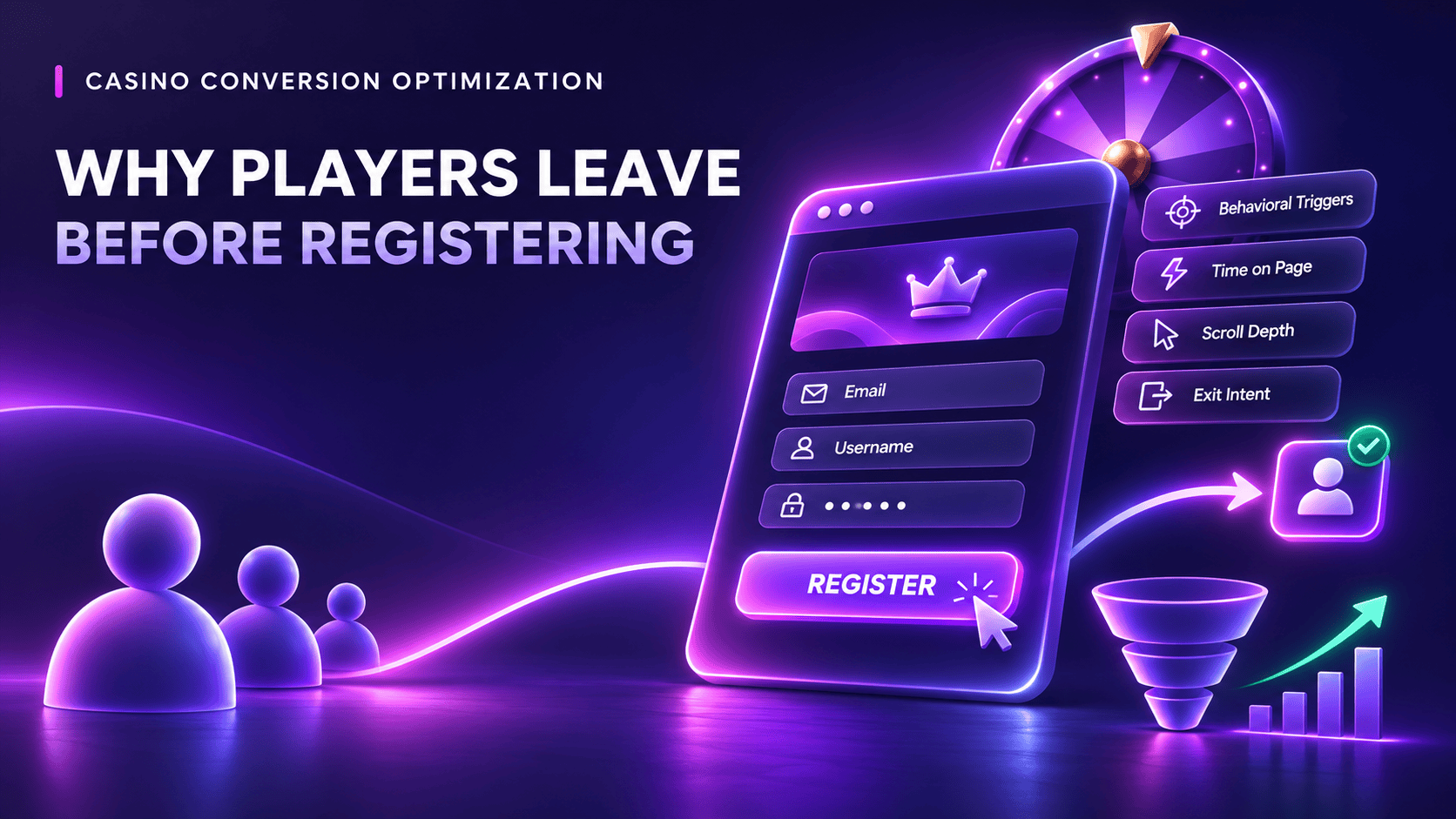
Spark allows operators to configure behavior-triggered onsite experiences using signals such as:
- Exit intent.
- Time on page.
- Scroll depth.
- Page visits.
- Button interactions.
Those triggers can activate configurable experiences including spin wheels, scratch cards, mystery boxes, and targeted banners.
For example, an eligible visitor exploring a promotional landing page could be shown a relevant interactive experience with a clearly communicated next step.
Instead of relying only on a passive registration button, the operator creates another opportunity for meaningful interaction.
Campaigns can be configured through a centralized dashboard and connected to acquisition measurement.
The objective is not to show every visitor another promotion.
It is to understand when an additional interaction can improve the journey—and when it should not be shown at all.
All onsite experiences should respect age restrictions, jurisdictional requirements, promotional eligibility, consent, and applicable responsible-gambling safeguards.
What to measure: Engagement rate, interaction-to-registration rate, incremental registration lift versus a control group, and first-time-deposit conversion where appropriate.
How to Identify Where Your Casino Is Losing Potential Registrations
Before changing your website, establish a clear view of the acquisition funnel.
A useful measurement framework separates traffic, engagement, registration, and activation.
| Funnel stage | Primary KPI | What it helps identify |
|---|---|---|
| Landing page | Eligible visitor-to-registration-start rate | Whether visitors understand the proposition and begin registration |
| Pre-registration engagement | Interactive experience participation rate | Whether visitors engage with relevant onsite experiences |
| Registration | Form completion rate | Whether the signup process creates avoidable friction |
| Verification | Verification completion rate | Whether required checks are clearly communicated and accessible |
| Activation | Verified registration-to-first-deposit rate | Whether new accounts progress to the next eligible lifecycle stage |
| Acquisition efficiency | Cost per qualified registration | Whether improvements generate commercially relevant outcomes |
These metrics should be segmented by acquisition channel, campaign, device, country, and landing page where data is sufficient.
A low registration rate from one affiliate may reflect traffic-quality or message-match problems.
A low form completion rate across all channels may indicate a registration UX issue.
Those require different interventions.
A practical CRO improvement framework
Start with four questions:
1. Where is the largest measurable drop-off?
Identify the stages losing the highest proportion of eligible users.
2. What evidence explains the friction?
Combine analytics with form-error data, usability testing, session observations where lawful, and customer support feedback.
3. What is the smallest meaningful change you can test?
That may be improving the first-screen CTA, clarifying a promotional condition, simplifying an optional field, or introducing a contextual onsite experience.
4. Did the change improve qualified outcomes?
Measure the result against an appropriate baseline or control group.
Do not assume a higher interaction rate automatically represents better business performance.
A successful experiment should improve the intended stage without negatively affecting player quality, compliance, responsible-gambling outcomes, or downstream activation.
Why Registration Conversion Is Only the Beginning
An important mistake in casino CRO is optimizing registration without considering what happens afterward.
A registration is valuable because it begins a potential customer relationship.
However, not every completed registration becomes an active, verified, or depositing customer.
That is why acquisition should connect to the wider player journey:
Visitor → Interaction → Registration → Verification → Activation → Engagement → Retention → Loyalty
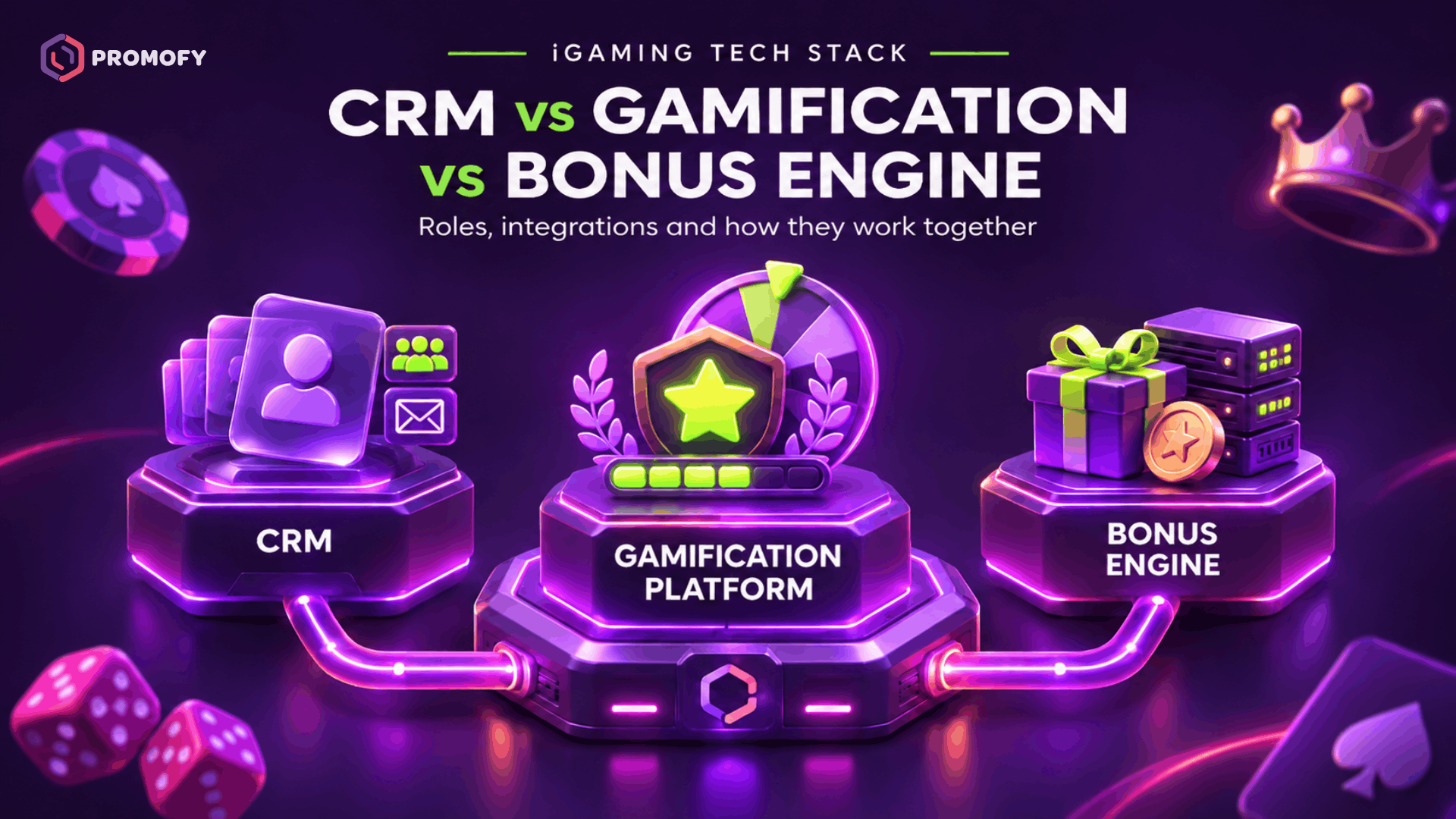
Different technologies support different parts of that journey.
A registration form helps create an account.
A CRM manages customer data and lifecycle communications.
A bonus engine manages eligible incentives and reward fulfillment.
A gamification layer creates interactive experiences, progression, and engagement opportunities.
An acquisition engagement tool can address the moment before registration.
The opportunity comes from connecting those systems rather than optimizing each in isolation.
How Promofy Connects Acquisition, Engagement, and Retention
Promofy is designed around a broader approach to player engagement: connecting the first interaction with the experiences that follow.
Three parts of the ecosystem are particularly relevant.
Promofy Spark: Pre-Registration Engagement
Promofy Spark focuses on converting anonymous website traffic into measurable acquisition opportunities through behavior-triggered, interactive onsite campaigns.
It supports the stages where visitors may be interested but have not yet registered.
Promofy Gamification Suite: Activation and Progression
Once players have entered the eligible customer lifecycle, the Promofy Gamification Suite provides mechanics such as missions, challenges, levels, rewards, leaderboards, and progression journeys.
These can help operators create structured onboarding and longer-term engagement experiences around their existing technology infrastructure.
Promofy AI Suite: Smarter Campaign Execution
The Promofy AI Suite supports campaign generation, behavioral segmentation, localization, visual creation, and campaign performance analysis.
Together, these capabilities support a more connected approach to campaign planning and player engagement.
Importantly, an engagement layer is not a replacement for core registration UX, identity verification, regulatory controls, or player-account management.
Its value is in making eligible interactions more relevant, measurable, and connected to the wider customer journey.
Frequently Asked Questions About Casino Conversion Rate Optimization
What is a good conversion rate for an online casino?
There is no universally reliable conversion benchmark that applies to every online casino.
Registration performance depends on traffic source, brand recognition, market, acquisition intent, verification requirements, device, and how conversion is defined.
Operators should establish consistent internal baselines and evaluate performance by comparable segments rather than relying on a single industry-wide number.
How can online casinos increase registration conversion?
Operators can improve registration conversion by aligning landing pages with acquisition campaigns, strengthening trust, optimizing mobile usability, simplifying unnecessary form complexity, explaining verification requirements, clarifying promotional conditions, and testing relevant pre-registration engagement.
Can gamification improve casino acquisition?
Gamification can support acquisition by creating interactive experiences before and after registration.
For example, eligible visitors may interact with a contextual onsite campaign before creating an account.
However, operators should test whether those experiences produce incremental qualified registrations rather than assuming that higher interaction automatically leads to better acquisition performance.
How is casino conversion optimization different from player retention?
Conversion optimization focuses on helping eligible visitors progress through acquisition and activation stages.
Player retention focuses on the experience after account creation, including ongoing engagement, progression, loyalty, and repeat participation.
The two are connected, but they address different lifecycle challenges.
Does registration optimization conflict with KYC requirements?
It should not.
Effective CRO removes unnecessary friction while preserving legally required identity verification, age checks, responsible-gambling controls, and other applicable obligations.
Operators should design compliant journeys that clearly explain each required step.
Final Thoughts: Stop Treating Traffic as the Only Acquisition Problem
Online casino acquisition is not just about bringing more visitors to a website.
It is about what happens after they arrive.
A strong acquisition strategy should answer several questions:
Can visitors find what they expected?
Do they trust the platform?
Is registration straightforward?
Are verification requirements understandable?
Is the promotional value clear?
Does the website respond appropriately to meaningful visitor behavior?
And does the registration journey connect to a longer-term customer experience?
Improving these areas can help operators make better use of existing acquisition traffic without depending exclusively on larger media budgets or increasingly aggressive incentives.
The next opportunity in casino CRO is not simply another landing-page redesign.
It is connecting visitor behavior, contextual interaction, registration, and activation into a measurable journey.
Turn More Visitor Interest Into Measurable Acquisition Opportunities
Your website may already be attracting visitors who are interested in registering.
The question is whether your current acquisition experience recognizes that interest before it disappears.
Discover how Promofy Spark can help you create behavior-triggered onsite experiences, connect interactive campaigns to registration outcomes, and make better use of existing acquisition traffic.