
Modern iGaming operators rarely struggle with a lack of technology. Most already have a Player Account Management (PAM) system, a CRM platform, a bonus engine, analytics tools, and several marketing integrations. Yet connecting these systems into a consistent player engagement experience remains a challenge.
A CRM might identify the right player segment, a bonus engine might issue a promotional reward, and a gamification platform might introduce missions, challenges, or progression mechanics. Each system has an important role, but the boundaries between them are not always clear.
This creates a practical challenge for casino and sportsbook operators evaluating new technology: Do you need another CRM, a more flexible bonus engine, or a dedicated gamification layer that works with your existing infrastructure?
Understanding the difference is essential for making better integration decisions, avoiding duplicate functionality, and creating engagement journeys that operate across multiple systems.
This guide breaks down the responsibilities of each platform, explains how player events and rewards move through a typical iGaming architecture, and explores what operators should consider before introducing new gamification technology.
Three Different Systems, Three Different Responsibilities
Although CRMs, bonus engines, and gamification platforms often share features, they are built around different primary objectives.
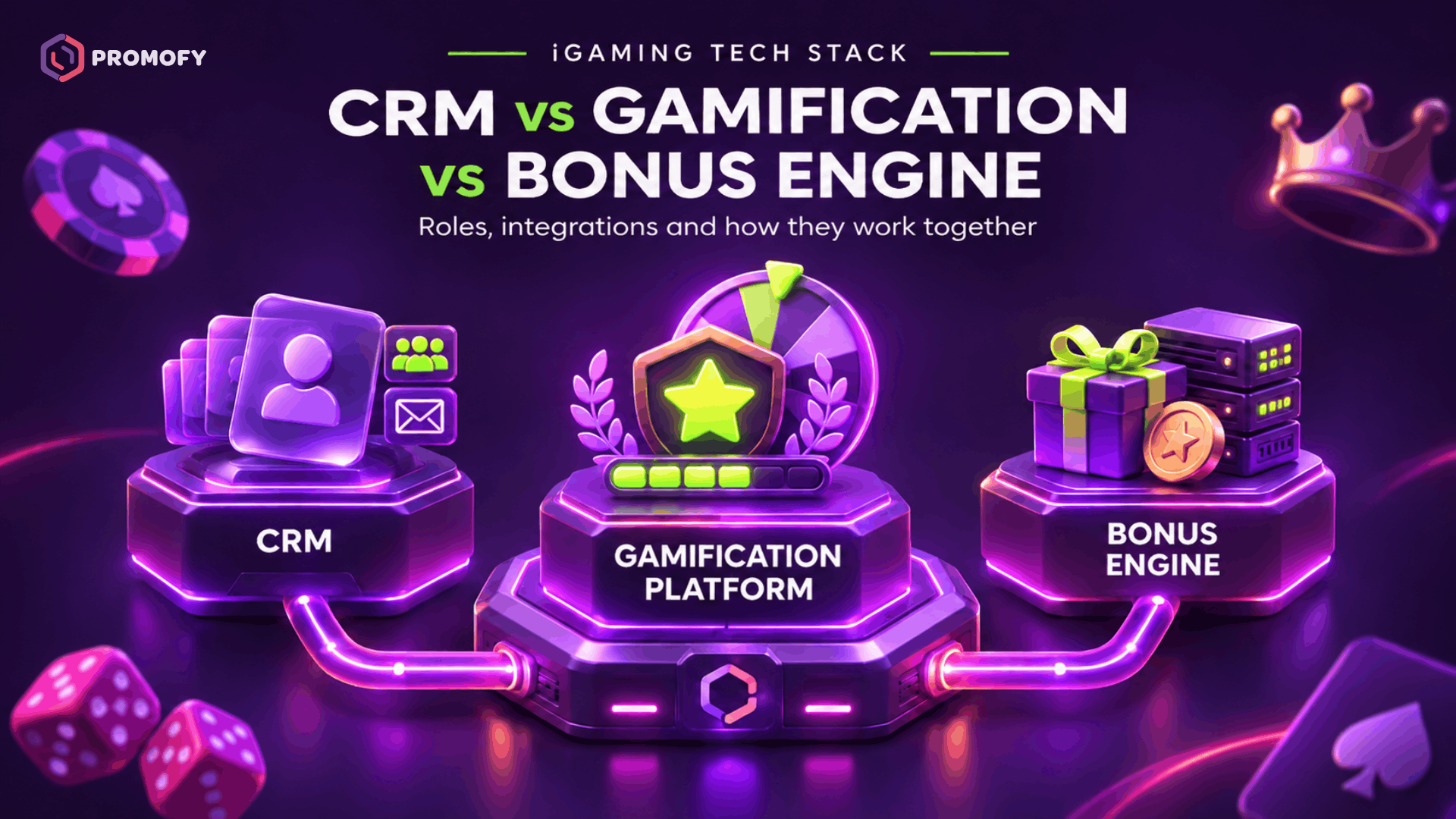
A CRM focuses on customer information, segmentation, and communication. A bonus engine manages promotional entitlements, reward rules, and financial execution. A gamification platform introduces interactive experiences, progression, and continuous participation.
The distinction becomes clearer when comparing their responsibilities.
| Capability | iGaming CRM | Gamification Platform | Bonus Engine |
|---|---|---|---|
| Primary purpose | Customer lifecycle management | Interactive engagement | Promotional reward execution |
| Player segmentation | Core functionality | Uses or enhances segments | Applies eligibility conditions |
| Email, SMS, and push | Core functionality | Usually via CRM integration | Usually via CRM integration |
| Missions and challenges | Limited or integration-based | Core functionality | Usually not core |
| XP, ranks, and progression | Varies by provider | Core functionality | Limited or separate |
| Bonus allocation | Triggers or coordinates | Requests or orchestrates | Core functionality |
| Wagering requirements | Usually external | Usually external | Core functionality |
| Player-facing experiences | Messaging and journeys | Games, missions, rewards, progression | Bonus availability and status |
| Primary integration | PAM, channels, analytics | PAM, CRM, bonus engine, frontend | PAM, wallet, gaming systems |
These boundaries are not absolute. Some enterprise CRMs include loyalty or gamification features, while certain iGaming platforms combine all three functions within one ecosystem. The important question is not which vendor offers the longest feature list, but which system should own each responsibility.
What Does an iGaming CRM Actually Do?
A Customer Relationship Management platform is responsible for understanding the customer relationship and coordinating communication throughout the player lifecycle.
In iGaming, CRM platforms typically connect player information from the PAM, casino platform, sportsbook, and analytics infrastructure. That information helps marketing and retention teams build segments, configure automated journeys, and deliver relevant messages through different channels.
For example, a CRM might identify newly registered customers who have completed verification but have not yet explored the available products. It could then initiate an onboarding journey with relevant information, an introduction to key platform features, or an invitation to participate in an eligible activity.
Where CRM Platforms Deliver the Most Value
The strength of a CRM comes from its ability to organize customer data and coordinate lifecycle communications.
Typical capabilities include behavioral segmentation, scheduled and event-triggered campaigns, email and push automation, customer journey builders, communication preferences, and campaign performance reporting.
However, identifying a customer segment and delivering a message do not automatically create an engaging experience.
A CRM can send a notification announcing a new challenge, but another system may be needed to calculate the challenge’s progress, manage its rules, update the player’s achievements, and display the results in the operator’s interface.
This is where a dedicated gamification platform can add functionality beyond traditional CRM automation.
What Does an iGaming Gamification Platform Actually Do?
An iGaming gamification platform is designed to transform qualifying player actions into structured interactive experiences.
Instead of treating each promotion as a separate campaign, gamification connects activities through missions, achievements, progression systems, loyalty mechanics, challenges, and rewards.
The objective is to provide a consistent experience in which players can understand their progress, participate in relevant activities, and see the results of their actions.
From Individual Promotions to Connected Experiences
Consider a casino operator running a conventional welcome campaign.
The CRM identifies eligible new customers and sends a welcome message, while the bonus engine manages any applicable promotional offer. Once that interaction is completed, the campaign may have no further connection to the customer’s broader experience.
A gamification platform introduces additional possibilities.
The operator could configure an onboarding journey in which eligible customers explore platform features, complete an introductory quiz, participate in a free-to-play activity, or unlock non-monetary achievements. Completing these activities could contribute to a visible progression system, with subsequent experiences determined by the player’s eligibility and preferences.
This creates an engagement structure rather than a sequence of disconnected promotions.
The Role of Real-Time Player Events
Gamification platforms rely on player activity data to evaluate progress and determine which actions have been completed.
Depending on the implementation, events might include account registration, verification completion, campaign participation, qualifying game activity, settled sports bets, or loyalty milestones.
An event-driven engagement layer can evaluate these actions against configured campaign rules and update the relevant experience without waiting for the next scheduled CRM campaign.
However, real-time responsiveness depends on the complete integration. Receiving an event quickly does not guarantee that eligibility checks, reward execution, and the frontend will update at the same speed.
As explored in Slow Rewards Kill Retention: Why Real-Time Gamification in iGaming Drives Player LTV, the timing between player activity, engagement logic, and visible feedback is an important part of the experience.
What Does a Casino Bonus Engine Actually Do?
A bonus engine is responsible for applying promotional reward rules and coordinating the execution of bonus entitlements.
It typically operates close to the operator’s core platform, wallet, and gaming infrastructure because bonus execution can affect balances, wagering conditions, expiration rules, financial reporting, and regulatory obligations.
For example, when an eligible player receives a free-spin promotion, the bonus engine or connected gaming provider must determine how that entitlement is issued, what restrictions apply, and how its lifecycle is tracked.
A gamification platform might identify that a player has completed a qualifying mission. The bonus engine, or the relevant reward-authority system, then handles the resulting monetary or gaming entitlement.
Why Bonus Engines and Gamification Platforms Are Not Interchangeable
A bonus engine answers questions such as:
- Is this player eligible to receive the promotion?
- What reward amount or entitlement is authorized?
- Which wagering, expiration, and jurisdictional rules apply?
- Has the promotion already been claimed?
- How should the reward be recorded, reconciled, or reversed?
A gamification platform answers a different set of questions:
- Which interactive experience should the player participate in?
- What actions contribute to mission or challenge progress?
- How should achievements, levels, or loyalty progression change?
- What should appear in the player interface after completion?
- Which eligible experience can follow the completed activity?
Some systems support both responsibilities. However, operators should still establish which component has final authority over promotional entitlements and player balances.
A gamification reward is not necessarily a financial bonus. XP, badges, virtual achievements, and non-monetary progression can be managed within an engagement layer. Free spins, free bets, bonus funds, or other financially relevant entitlements generally require integration with the system authorized to issue them.
How CRM, Gamification, and Bonus Engines Work Together
The most useful way to understand iGaming gamification platform integration is to follow the flow of information between systems.
A typical architecture contains several connected components.
1. Player Account Management and Core Platform
The PAM manages player identity and account state, while the wallet and related systems maintain authoritative financial records. The core platform also connects relevant verification, jurisdictional, consent, and safer-gambling controls.
2. CRM and Customer Data
The CRM consumes relevant player information and uses it to build segments, manage communication preferences, and coordinate lifecycle campaigns.
3. Gamification and Engagement Layer
The gamification platform receives permitted player events and campaign context, evaluates engagement rules, tracks progression, and provides interactive experiences through frontend integrations.
4. Bonus Engine and Reward Systems
The bonus engine, wallet, sportsbook, or gaming provider executes supported reward entitlements. The responsible system confirms whether the reward was successfully issued.
5. Analytics and Reporting
Campaign outcomes, player interactions, reward status, and relevant commercial metrics are shared with reporting systems so operators can evaluate the complete experience.
A Practical Player Event-to-Reward Example
Imagine an eligible player participating in an onboarding mission that includes completing an introductory free-to-play prediction.
The operator has configured a campaign in which completing the activity unlocks progression points and, where permitted, a promotional entitlement.
A possible integration workflow would look like this:
- The core platform confirms the player context. The account, relevant eligibility conditions, and participation permissions are established.
- The CRM determines the campaign audience. The player belongs to an eligible onboarding segment, and the CRM can initiate the relevant customer journey.
- The gamification platform displays the activity. The player sees the mission, its requirements, and any applicable reward conditions.
- A qualifying event is received. The system responsible for the activity sends a completion event containing the necessary player, campaign, and event identifiers.
- The gamification platform updates progression. It evaluates the event, records mission completion, and updates any non-monetary achievements or XP.
- The reward request is evaluated. Where a promotional entitlement is involved, the appropriate reward system rechecks current eligibility and applicable rules before execution.
- The reward authority confirms the outcome. A successful issuance produces a confirmation that can be reflected in the gamification experience and CRM history. Failed or pending requests are handled without presenting an unissued bonus as available.
- The CRM and reporting systems receive the outcome. The operator can measure the player’s participation and continue the permitted lifecycle journey using updated information.
The result is a connected experience in which each system performs a defined responsibility.
Importantly, this workflow does not require every system to duplicate the same player database, bonus calculations, or campaign logic.
The APIs and Integration Requirements Operators Should Evaluate
The architecture can look straightforward in a presentation. In production, successful integration depends on how accurately, securely, and consistently the systems exchange information.
A strong technical evaluation should address the following areas.
1. Event Availability and Data Quality
The gamification platform needs access to the player events required by its mechanics. Operators should verify which events their existing infrastructure can provide and whether those events represent completed, pending, reversed, or canceled actions.
For example, a sportsbook promotion based on settled bets cannot reliably calculate progress using bet placement events alone if the campaign rules require final settlement.
Event payloads should include stable identifiers, relevant timestamps, brand or market context, and enough information to evaluate a campaign without unnecessary personal data.
2. API and Event Delivery Methods
Not every integration needs the same architecture. REST APIs, webhooks, event streams, and scheduled data imports all support different use cases.
APIs can support direct requests and configuration operations. Webhooks and event streams are useful for passing activity updates and outcomes between systems, while scheduled imports may be appropriate for lower-frequency audience management.
The integration method should reflect the campaign’s timing requirements, event volume, and the operator’s existing technical environment.
3. Identity and Segmentation
Systems must agree on which player, brand, and market an event belongs to. Operators should establish a consistent identifier strategy and avoid relying on unverified client-side data for sensitive decisions.
It is also important to distinguish between a CRM segment and final promotional eligibility. A player might belong to a marketing segment but become ineligible for a promotion because of an updated account restriction, consent status, or jurisdictional rule.
The latest authoritative eligibility information must take precedence over an outdated campaign audience.
4. Reward Execution and Idempotency
Duplicate events and network retries are normal integration challenges. Financially relevant reward operations must be designed so that repeated delivery of the same request cannot create unintended duplicate credits.
Operators should evaluate idempotency keys, reward identifiers, acknowledgment responses, retry handling, and reconciliation procedures.
The integration also needs a documented approach for failed requests, temporarily unavailable systems, reversed transactions, and disputes between the gamification state and the wallet or bonus ledger.
5. Player Experience and Frontend Integration
The gamification layer may manage mission progress, but players experience the result through the website or mobile application.
Operators should evaluate frontend components, authentication, loading behavior, localization, and synchronization of progress across devices.
For a reward-dependent mechanic, the interface should clearly distinguish between a completed mission, a reward that is pending issuance, and a reward that has been successfully granted.
These details matter because even an accurate backend can create a poor experience when the interface communicates the wrong state.
6. Security, Compliance, and Auditability
Integration requirements must include authentication, authorization, data minimization, and reliable audit records. Operators also need appropriate controls for campaign approvals, financial limits, and jurisdiction-specific restrictions.
These safeguards are particularly important when gamification experiences involve monetary rewards or player activity associated with gambling.
The UK Gambling Commission’s remote customer interaction requirements provide a useful example of why engagement systems must support timely restrictions. In relevant licensed operations, strong indicators of gambling harm require measures that prevent marketing and the take-up of new bonus offers.
Responsible-gambling protections must therefore be part of the integration architecture, not an optional campaign setting.
Three Common Integration Approaches
There is no single architecture that works for every operator. The right approach depends on the existing technology stack, available APIs, ownership of player data, and level of control required.
Approach 1: All-in-One iGaming Platform
Some operators use an integrated environment where CRM, loyalty, bonus management, and engagement functionality are included within one platform.
This can simplify vendor management and reduce the number of external integration points. However, operators may be limited by the features and development roadmap of their existing provider.
For teams evaluating this approach, the main question is whether the built-in gamification capabilities provide sufficient flexibility, depth, and customization for their engagement strategy.
Approach 2: CRM-Led Engagement with a Gamification Integration
In this model, the CRM continues to own segmentation and lifecycle orchestration, while a gamification platform supplies interactive mechanics.
A CRM journey can determine when an eligible player should receive an experience. The connected engagement platform manages the mission, game, challenge, or progression mechanic, then returns useful participation outcomes.
This approach is particularly relevant for operators that already have established CRM processes and want to introduce gamification without rebuilding their existing customer journeys.
Approach 3: Dedicated Gamification Layer Connected to the Operator Platform
A dedicated gamification platform can also operate as an engagement layer connected directly to permitted core-platform events, with optional CRM integration.
In this model, the gamification system handles configured engagement logic while the existing operator infrastructure maintains authority over identity, monetary rewards, and financial transactions.
The benefit is flexibility. Operators can introduce new engagement experiences while retaining their existing PAM, wallet, CRM, and bonus infrastructure.
The trade-off is integration responsibility. Event quality, ownership boundaries, frontend compatibility, and reward execution must all be defined before launch.
Where Promofy Fits Into the iGaming Technology Stack
Promofy is designed to operate as an API-first engagement and gamification layer that connects with the technology operators already use.
Rather than requiring operators to replace their CRM or bonus engine, Promofy focuses on connecting player activity with interactive engagement experiences across acquisition, activation, retention, and loyalty.
Through the Promofy Gamification Suite, operators can create connected experiences using missions, unlockable challenges, levels, ranks, XP, loyalty journeys, rewards, wheels, mystery boxes, and other configurable mechanics.
These experiences can operate alongside existing operator systems, with CRM data and player events helping determine when and how players interact with the engagement layer.
Connecting CRM Orchestration With Interactive Experiences
Promofy supports API-based integration with CRM environments such as Fast Track and Optimove, as well as custom systems.
Its collaboration with Symplify also illustrates the distinction between CRM orchestration and gamification execution. In the described integration, Symplify handles player segmentation, targeting, and automated customer journeys, while Promofy provides the interactive experiences triggered within those journeys.
This approach allows operators to connect gamification with established CRM workflows rather than treating every mechanic as an isolated campaign.
Working With Existing Bonus Engines
Promofy’s engagement architecture also supports reward workflows connected to an operator’s existing bonus infrastructure.
A mission or challenge can determine when a promotional reward should be requested, while the connected bonus engine or other authorized reward system applies the relevant reward rules and executes the entitlement.
The exact workflow depends on the operator’s existing platform, available integrations, and supported reward types.
For operators with several brands or markets, Promofy also provides multi-brand management, multilingual configuration, analytics, and a centralized environment for managing gamification campaigns.
The value is not simply having more promotional mechanics available. It is creating a connected engagement layer that can operate within the operator’s wider technology ecosystem.
How to Evaluate an iGaming Gamification Platform Before Integration
Before selecting a platform, operators should evaluate it against specific technical and operational requirements rather than relying on a feature comparison alone.
The following questions provide a useful starting point:
- Which systems remain authoritative? Establish ownership of player identity, segmentation, progression, bonuses, financial balances, and regulatory restrictions.
- Which events are available? Confirm that the existing platform can provide the events required for missions, challenges, loyalty programs, and other planned experiences.
- How are rewards executed? Identify which component issues monetary and non-monetary rewards, confirms fulfillment, and handles failed or repeated requests.
- Can the platform support existing CRM workflows? Evaluate whether audience targeting and engagement results can be exchanged without duplicating customer-management processes.
- How will the experience appear to players? Review frontend integration, mobile compatibility, authentication, localization, and visible reward states.
- Can the integration support multiple brands and markets? Verify tenant separation, configuration flexibility, and jurisdiction-specific controls.
- How will the operator measure results? Determine whether campaign engagement, reward costs, incremental behavior, and relevant commercial metrics can be connected through reporting.
- What happens when something fails? Review event retries, system availability, reward reconciliation, support ownership, and auditability.
A successful proof of concept should test at least one complete journey, from an eligible player event through engagement processing and any required reward confirmation, rather than demonstrating an interactive mechanic in isolation.
Measuring the Value of Connected Gamification
Integration success should not be measured only by the number of active campaigns or the speed at which a new mission can be launched.
Operators should evaluate whether the connected experience improves relevant business outcomes while maintaining appropriate cost and player-protection controls.
At the engagement level, metrics might include mission participation, completion rates, repeat participation, and progression activity. At the operational level, important indicators include event-processing latency, reward issuance success, error rates, and reconciliation exceptions.
Commercial measurement should focus on incremental outcomes such as qualified activation, retention, or customer value, assessed against a suitable comparison group and adjusted for campaign costs.
Promotional ROI also requires a complete view of reward expenditure. Without data from the bonus engine and financial reporting infrastructure, a gamification dashboard may show strong participation without demonstrating whether the campaign created additional value.
For a more detailed measurement framework, explore Gamification ROI for Online Casinos: KPIs and Performance Measurement.
Frequently Asked Questions
What is the difference between an iGaming CRM and a gamification platform?
An iGaming CRM primarily manages player data, segmentation, communications, and customer lifecycle journeys. A gamification platform focuses on interactive experiences such as missions, challenges, achievements, progression, and loyalty mechanics. Integrating them allows CRM journeys to trigger relevant experiences and use engagement outcomes in subsequent campaign decisions.
Can a gamification platform replace a bonus engine?
Not necessarily. A gamification platform may manage progression points, achievements, and reward orchestration, but regulated promotional entitlements often require an existing bonus engine, wallet, or another authorized reward system. Operators should confirm exactly which responsibilities each platform supports before deciding whether any functionality can be consolidated.
Does an iGaming gamification platform need a CRM integration?
No. Some gamification platforms can operate using direct player events, configurable eligibility rules, or imported segments. However, CRM integration can be valuable when an operator wants gamification experiences connected to existing segmentation, communication, and lifecycle workflows.
How does an iGaming gamification API integration work?
A typical integration connects player identity and permitted activity events from the operator’s infrastructure with a gamification platform. The engagement layer evaluates the relevant mechanics, updates progression, and may coordinate reward requests with authorized systems. Frontend components and reporting integrations then display outcomes and make relevant engagement data available to the operator.
Should casino operators use an all-in-one platform or a dedicated gamification solution?
Both approaches can work. An all-in-one platform can reduce vendor management and integration complexity, while a dedicated gamification layer may provide greater flexibility for operators that already have established technology infrastructure. The decision should depend on feature requirements, integration quality, operational ownership, total cost, and the operator’s long-term product roadmap.
The Future of iGaming Engagement Is Connected, Not Isolated
CRM platforms, bonus engines, and gamification systems are not necessarily competing solutions. They address different responsibilities within the same player engagement architecture.
CRM provides customer context and communication orchestration. Bonus engines execute promotional entitlements under defined financial and regulatory rules. Gamification platforms turn permitted player actions into interactive experiences, progression, and connected engagement journeys.
The opportunity for iGaming operators is to make these capabilities work together without creating unnecessary technical complexity.
A well-designed integration allows player events to flow between systems, engagement decisions to use current information, rewards to be executed by the appropriate authority, and campaign results to become part of the wider customer journey.
The goal is not to add another disconnected tool. It is to make the technology operators already have work better together.
Make Gamification Part of Your Existing Stack
Promofy helps casino and sportsbook operators connect interactive engagement experiences with existing CRM, platform, and bonus infrastructure.
Explore how missions, challenges, progression, loyalty, and rewards can become part of a connected engagement strategy without replacing the systems your business already relies on.

